


News
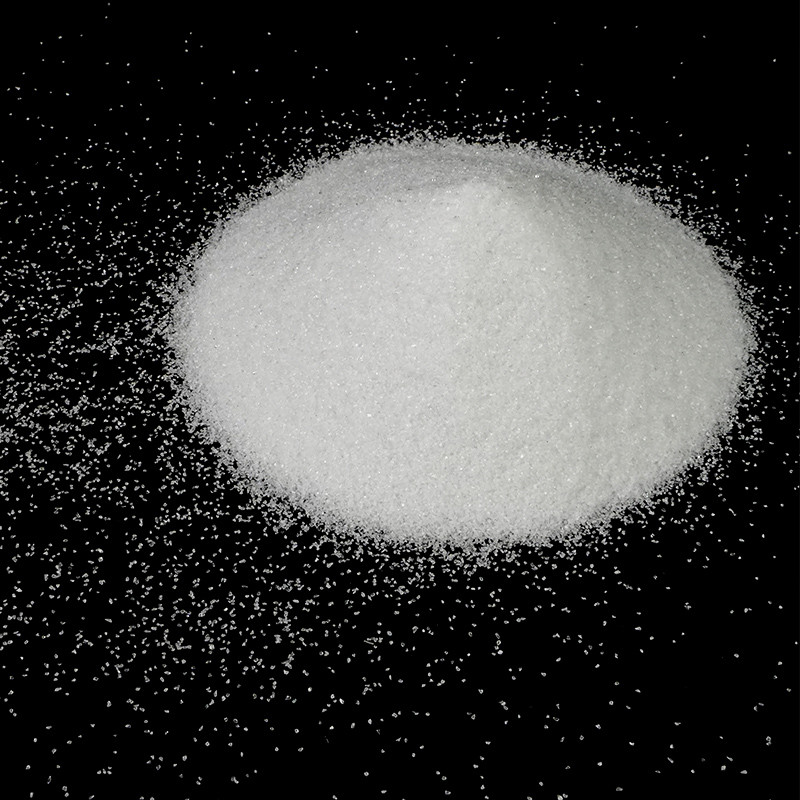
As a material in the field of artificial abrasives,white fused alumina holds a core position in precision processing,refractory materials and manufacturing due to its unique physicochemical properties。This article will examine its crystal structure,core performance and application scenarios from three dimensions,revealing the scientific basis behind its performance advantages。
I、Microstructure:Construction of α-Al₂O₃ crystals
The core performance of white fused alumina originates from its high-purity α-Al₂O₃ crystal structure。Through electric arc melting technology,industrial alumina powder undergoes phase transformation at high temperatures above 2000℃,forming α-Al₂O₃ crystals with a hexagonal close-packed structure。This crystal structure gives white fused alumina a Mohs hardness of 9.0(some literature records up to 10.0),second only to diamond。Its crystal size is controlled at the micron level,ensuring that the material can uniformly disperse stress when subjected to force and avoid brittle fracture。
In terms of particle size control,white fused alumina can achieve cross-scale preparation from F4(3.35mm)to W0.5(13μm)。Among them,micropowder-grade products(particle size<60μm)undergo ultrafine grinding and magnetic iron removal through a tube mill,with the particle size distribution error controlled within ±5%。This particle size accuracy enables it to meet different processing requirements,for example,W7-grade micropowder(particle size 14-20μm)is commonly used for ultra-precision grinding of optical lenses,while F220-grade abrasive grains(particle size 63-75μm)are suitable for surface polishing of die steel。
II、Core Performance:Synergistic effect of multidimensional advantages
Hardness and self-sharpening property
The Knoop hardness of white fused alumina reaches 2000-2200 Kg/mm²。During the grinding process,the Al-O bonds(bond energy 512kJ/mol)in its crystal structure can effectively resist plastic deformation。When abrasive grains become dull,microcracks in the crystal structure propagate along the(0001)crystal plane,causing the particles to fracture along the cleavage plane and form new sharp cutting edges。This self-sharpening property enables white fused alumina abrasives to maintain stable grinding efficiency during continuous operation,with a service life more than 30% longer than that of ordinary corundum。
Thermodynamic stability
White fused alumina has a true density of 3.95-4.0g/cm³,a melting point as high as 2050℃,and a thermal expansion coefficient of only(7-9)×10⁻⁶/K(0-1600℃)。In semiconductor wafer processing,its thermal conductivity(from room temperature to 900℃)can reach 9 Cal/cm³·sec·℃,effectively dispersing grinding heat and preventing thermal damage to the workpiece。
Chemical inertness
In strongly corrosive media such as aqua regia and hydrofluoric acid,the corrosion rate of white fused alumina is lower than 0.01g/m²·h,and it reacts only slightly with hot strong alkali solutions。This property makes it an ideal material for applications such as chemical equipment linings and semiconductor wafer carriers。
Surface treatment compatibility
Micropowder-grade white fused alumina(W0.5-W63)can control iron content below 0.03% through acid washing,meeting the processing requirements of aerospace titanium alloys,medical devices and other applications where iron contamination is strictly prohibited。Its low oil absorption property(<15%)allows polishing slurries to disperse more uniformly,improving surface smoothness。
III、Industrial Applications:A leap from microscopic precision to macroscopic efficiency
In the field of precision optics,white fused alumina micropowder combined with magnetorheological polishing technology can reduce the surface roughness of optical lenses to the Ra0.01nm level,meeting high-precision requirements for space cameras,laser communications and other applications。In semiconductor manufacturing,its high-hardness property is used in wafer back-grinding processes,controlling thickness tolerance within ±1μm。
In the field of refractory materials,white fused alumina-based castables still maintain structural integrity at a high temperature of 1900℃,and when applied to ladle linings,they extend service life by 3 times。Its low thermal expansion coefficient(7-9×10⁻⁶/K)effectively reduces thermal stress cracks and improves the safety of high-temperature equipment。
In the field of eco-friendly coatings,white fused alumina spraying technology forms a three-dimensional network structure,which not only improves thermal insulation performance(thermal conductivity<0.05W/m·K),but also provides Class A fire resistance,offering a new material solution for building energy conservation。
The performance advantages of white fused alumina stem from the precision of its crystal structure,the purity of its chemical composition and the advancement of its preparation process。From microscopic cutting to macroscopic thermal protection,white fused alumina is continuously expanding its application boundaries in fields such as quantum computing chip processing and nuclear fusion device linings through technological iterations such as nanosizing and compositing,becoming a core force driving manufacturing in the Industry 4.0 era。
News

Online Message
*We respect your confidentiality and all information is protected.